
More on Tag Allocation ISSUES
Draw Tag Allocation - Privatization
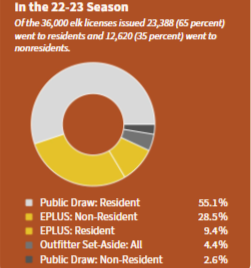
The first issue is how many tags are submitted for the draw pool. We’ll look at these statistics from the 2022-2023 elk tag distribution. This graph focuses on the distribution of all elk tags, but let’s break this down into draw tag distribution.
Looking at this data, we see that 37.9% of tags were distributed via the EPLUS system, a private landowner distribution system (more information below). These tags are then distributed by those landowners and are not available to the general public. So far - of 36,000 available tags, 13,644 have already been distributed to private interests. This leaves 22,356 tags available for the draw.
Now, of the draw tags, distribution is bound by the 84-10-6 percentage rules codified by the NM statute. Again, in this case data, 55.1% of the total tags went to public draw residents for a total of 19,836 draw tags distributed to residents. This distribution is 88.7% of the draw tags going to public residents. However, this is only 55.1% of all elk tags being distributed and available to the general public.
This example is for elk tag distribution, but it is not exclusive to elk and is common in the tags for big game in New Mexico.
https://www.nmwildlife.org/ip2-tag-allocation-dive#privatization
TakeBackYourElk.com, 2024 report
The 10% Outfitter Set-Aside
As part of the codified 84-10-6 draw distribution, up to 10% of draw tags may go to hunters submitting for a hunt with a verified licensed outfitter contract. This means that if you submit for the draw but also pay for an outfitter contract, this will put you in a separate category of the draw tags. This essentially means that if you are willing to pay more money for your hunt, you can increase your chances of receiving a tag.
Let’s look at an example of the difference of odds from a hunter’s calculation from 2026:
This hunter submitted for Unit ##, a unit that he is familiar with and knows is not a very popular location request for an elk tag. He calculated his chance of getting a tag from the public draw as 74%. He did not draw this year and has not drawn an elk tag in many years. However, if he booked any outfitter contract and submitted that with his draw, his chances for a tag would have become 100%. He would have been guaranteed an elk tag because he was willing to pay for the opportunity.
https://www.nmwildlife.org/ip2-tag-allocation-dive#outfitter-set-aside
Bighorn Sheep
Tags are usually distributed to the 84-10-6 rule by draw type and by hunt code. To exemplify this, if you have 100 tags in one unit (location) for one date range, 84 would go to residents, 10 to outfitters, and 6 to non-residents.
The issue with bighorn sheep tags is that the department of wildlife lumps all the bighorn sheep tags together despite location or hunting dates. If these tags were separated as they normally would be under statute, all the tags would be allocated to residents in order to meet the 84% minimum requirement. Grouping them together means that bighorn sheep tags can now be distributed to the outfitter set-aside, and for non-residents.
https://www.nmwildlife.org/ip2-tag-allocation-dive#bighorn-sheep
Mule Deer, Pronghorn, Barbary Sheep, Oryx
The tags for these big game species are split between public land draw tags and private landowner tags. The public draw tags follow the 84-10-6 rule. However, the public draw pool only accounts for 37% of all tags distributed for these species. The other 63% are distributed to private landowners.
Private landowners have no limit on the number of tags they can request of these species and can sell these tags to hunters, with an average sale price of $2000 compared to the public price of
Private Vs. Public Tag Exceptions
The tags for these big game species are split between public land draw tags and private landowner tags. The public draw tags follow the 84-10-6 rule. However, the public draw pool only accounts for 37% of all tags distributed for these species. The other 63% are distributed to private landowners.
Private landowners have no limit on the number of tags they can request of these species and can sell these tags to hunters, with an average sale price of $2000 compared to the public price of
https://www.nmwildlife.org/ip2-tag-allocation-dive#deer-tags
ELK
Management Zones for ELK
The tags for these big game species are split between public land draw tags and private landowner tags. The public draw tags follow the 84-10-6 rule. However, the public draw pool only accounts for 37% of all tags distributed for these species. The other 63% are distributed to private landowners.
Private landowners have no limit on the number of tags they can request of these species and can sell these tags to hunters, with an average sale price of $2000 compared to the public price of
EPLUS - Elk Private Landowner U…. System
The tags for these big game species are split between public land draw tags and private landowner tags. The public draw tags follow the 84-10-6 rule. However, the public draw pool only accounts for 37% of all tags distributed for these species. The other 63% are distributed to private landowners.
Private landowners have no limit on the number of tags they can request of these species and can sell these tags to hunters, with an average sale price of $2000 compared to the public price of
Private Vs. Public Tag Exceptions
The tags for these big game species are split between public land draw tags and private landowner tags. The public draw tags follow the 84-10-6 rule. However, the public draw pool only accounts for 37% of all tags distributed for these species. The other 63% are distributed to private landowners.
Private landowners have no limit on the number of tags they can request of these species and can sell these tags to hunters, with an average sale price of $2000 compared to the public price of
New Mexico vs. other western states
The tags for these big game species are split between public land draw tags and private landowner tags. The public draw tags follow the 84-10-6 rule. However, the public draw pool only accounts for 37% of all tags distributed for these species. The other 63% are distributed to private landowners.
Private landowners have no limit on the number of tags they can request of these species and can sell these tags to hunters, with an average sale price of $2000 compared to the public price of
How this affects hunting traditions
The tags for these big game species are split between public land draw tags and private landowner tags. The public draw tags follow the 84-10-6 rule. However, the public draw pool only accounts for 37% of all tags distributed for these species. The other 63% are distributed to private landowners.
Private landowners have no limit on the number of tags they can request of these species and can sell these tags to hunters, with an average sale price of $2000 compared to the public price of
https://www.nmwildlife.org/ip2-tag-allocation-dive#affects-hunting